Wednesday, July 22, 2026

The day to Day


Off the Coast of Utopia my insights and comments about both my old and new work and see works in progress, sketches, and ideas.

Tuesday, April 10, 2018

Off the Coast with Paul Rhoads

This episode of the podcast is an interview with artist, writer and composer Paul Rhoads. Paul has some very interesting opinions and certainly is willing to go against popular thought. Our talk is mostly about painting and culture:
 Off the Coast with Paul Rhoads

For more about Paul check out his youtube channel: Thought Thug


A link to Rubens' book on the human figure: https://archive.org/details/theoriedelafigur00rube 


This video of Paul's gives an excellent introduction to what I call the perfect painting method:


Tuesday, March 20, 2018

Podcast is Back!


I am relaunching my podcast with an aim to make it a little more consistent. I will be interviewing individuals, mostly artists to start with, whose work I am interested in. These will be  fine and sacred artists as well as comic book artists and illustrators.

My first interview is with Kalman Andrasofszky. Kalman is a Toronto native, best know for his work on the relaunch of Captain Canuck. His career spans 17 years and includes card work, covers, a creator owned series for DC and a member of R.A.I.D. studios. To wrap it up we go in-depth into his work for Chapterhouse Comics. Hope you enjoy.

Click on this link:
Off The Coast with Kalman Andrasofszky
Podcast intro music "Amnesthesia" by Kid Cholera
Exit music : "More Like You" by Brave Shores

You can find Kalman here:
https://www.instagram.com/evilkalman/
https://www.raid.world
https://iamkalman.carbonmade.com


Saturday, June 10, 2017

The Figurative Sculpture of Northern Portugal: Part One - Praça da República, Porto

Northern Portugal is filled with interesting figurative sculpture. Mostly in bronze, they range from 19th century pieces up to the contemporary. I am not sure how the Portuguese managed to continue this wonderful tradition while the rest of Europe fell to the curse of the postmodern but I suspect it may have to do with the strong Catholic traditions embeded in the culture while Salazar was ruling the country. From the city to small village you will find interesting and often beautiful works.

To start this series lets take a look at Praça da República in Porto.The square was opened in the latter half of the 18th century. Shortly after the military headquarters was built on the north side and the area was used for military maneuvers. In 1910, upon the proclamation of the Republic, the square was further developed with the addition of flower beds and the sculptures below.


According to the plaque,  this Bacchus was erected in 1916 to commemorate the sixth anniversary of the Republic of Portugal. The sculptor was António Teixeira Lopes. 


This sculpture is titled, "Padre Américo". Américo Monteiro de Aguiar, better known by Father Américo (Penafiel, Galegos, 23 October 1887 - Campo, Valongo, July 16, 1956), was an important Portuguese benefactor who dedicated his life to the most deprived. Sculpture  by Henrique Arujo Moreira.


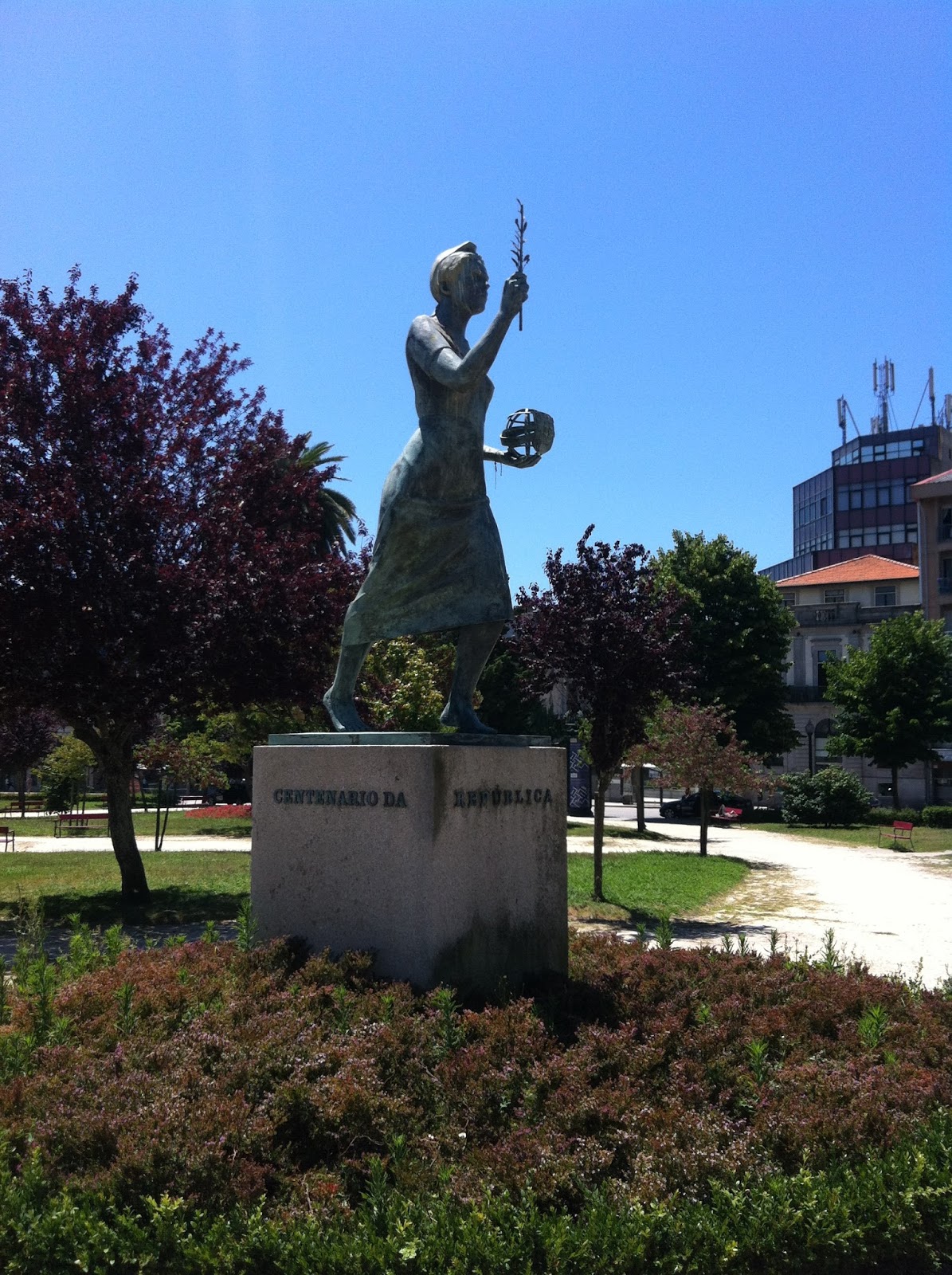
This allegorical sculpture by Bruno Marques commemorates the 100 anniversary of the Portuguese Republic. She is holding a palm branch (signifying peace) and a crest of Portugal. 


Sunday, April 16, 2017

THE RESURRECTION OF THE SON OF GOD

Alleluia. Christos Anesti. Christ is Risen!


The Passion and the Resurrection of Jesus Christ is the very heart of Christianity. As the Gospels and the Old Testament must be interpreted in  light of the Resurrection of Jesus Christ from the dead, so too must our lives.
The important news of the Resurrection needs to be affirmed and confirmed. The modern world’s misunderstanding of the meaning of the Passion and the Resurrection is profound. As predicted by St. Paul in 1, Thessalonians 4:13: “Brothers, we do not want you to be ignorant about those who fall asleep, or to grieve like the rest of men who have no hope.”1 Many around us are “without hope and without God in the world.”(Ep 2,12). The disintegration of the family, abortion, the rise of euthanasia, and an ever increasing desire to satisfy only the flesh are a reflection of the denial of the redemptive power of suffering. In his Apostolic Letter, Salvifici Doloris, Pope John Paul II offers enlightening words in this regard. Human suffering, has reached its culmination in the Passion of Christ and at the same time it has entered into a completely new dimension and a new order: it has been linked to love, to that love which creates good, also drawing it out from evil by means of suffering, just as the supreme good of the Redemption of the world was drawn from the Cross of Christ, and from that Cross constantly takes its beginning. The Cross of Christ has become a source from which flow rivers of living water.
Despite tremendous advances in health care and comfortable lives, we face something we cannot control: death. The more energy we spend soothing ourselves, the further we move away from an understanding of our true end and a denial of the resurrection.
And yet, the gospels speak:
"It is true! The Lord has risen and has appeared to Simon." Then the two told what had happened on the way, and how Jesus was recognized by them when he broke the bread. While they were still talking about this, Jesus himself stood among them and said to them, "Peace be with you. "They were startled and frightened, thinking they saw a ghost. He said to them, "Why are you troubled, and why do doubts rise in your minds? Look at my hands and my feet. It is I myself! Touch me and see; a ghost does not have flesh and bones, as you see I have." When he had said this, he showed them his hands and feet. And while they still did not believe it because of joy and amazement, he asked them, "Do you have anything here to eat?" They gave him a piece of broiled fish, and he took it and ate it in their presence. (Lk 24,34–43)
Myths, scattered throughout world history, speak of resurrection. In
Egyptian culture, concepts of an afterlife first appear with the sun gods. Later, the myth of Osiris has him brought back to life by Isis and become the judge of the dead. The eastern concept of reincarnation is related to resurrection. In Mesopotamia, we hear the story of Tammuz who was banished to the underworld but revived six months later. Attis was reborn as an evergreen tree, an event celebrated March 25 in the Phoenician civilization. The Greco- Roman world had Adonis. According to Homer when the ancient classical world spoke of bodily resurrection they only did so to deny it. Death could not be undone.3 Writers of the time maintained that the dead were in fact non-existent. Plato proposed a radically different view of resurrection. For Plato, the soul is the true form of the person. The body is temporary while the soul is forever. When a person dies his soul goes to Hades and there, judgment is passed on him.
The Judaic belief regarding life after death fall into three categories:
Initially, there was an absence of hope for life after death. Slowly, the idea that God’s love endures even after death developed, indicating some kind of afterlife. The final version built on this concept by including bodily life after death.4 Despite such beliefs, resurrection makes few appearances in the Old Testament. Into these worldviews Christianity was born. The first Christians insisted that Christ did rise bodily from the dead. This hope was at the center of Christianity. It was, at its core, a resurrection movement and its entire theology rested upon that one event: Jesus of Nazareth had been raised from the dead in a transformed body.5 In the Resurrection of Christ, myth and history meet and reality is transformed. 
As noted by by C.S. Lewis:
The heart of Christianity is a myth, which is also a fact. The old myth of the
dying God, without ceasing to be myth, comes down from the heaven of legend and imagination to the earth of history. It happens - at a particular date in a particular place, followed by definable historical consequences. We pass from a Balder or an Osiris, dying nobody knows when or where, to a historical person under Pontius Pilate. By becoming fact it does not cease to be myth: that is the miracle...this is the marriage of Heaven: Perfect Myth and Perfect Fact, claiming not only our love and obedience, but also our wonder and delight, addressed to the savage, the child, and the poet in each one of us no less than to the moralist, the scholar and the philosopher.
Details may differ and lengths vary, yet all four gospels share the story of a visit to the tomb by Mary Magdalene on the first day of the week. What she found was an empty tomb. Shortly thereafter, Christ begins to make appearances. The Lord appeared first to Mary Magdalene who did not recognize him. “Sir, if you have carried him away, tell me where you have put him, and I will get him.” (Jn 20,15). It was not until Jesus spoke her name that she recognized him. On the evening of that first day, “Jesus came and stood among them and said, "Peace be with you!" After he said this, he showed them his hands and side. The disciples were overjoyed when they saw the Lord.” (Jn 20,19–20). In Emmaus he remained unrecognized by the disciples until he broke bread.
The bodily resurrection continues the love shown by God in the Incarnation and affirms the goodness of God’s created realm. It demonstrates the importance of this created realm and more specifically the value of the body. It was upon this value that history was written for the last two millennia. For art history, the body became subject supreme as artist used it to express man’s place in the world and his relationship to God. Christ transformed body is revealed to us through the sacraments. We know from the experiences of the apostles that this revelation is not immediately visual. It takes place in the heart. “Then their eyes were opened and they recognized him, and he disappeared from their sight.” (Lk 24,31).
Modern psychology denies sin and rejects the idea of man’s fallen nature. Science disallows the possibility of resurrection and the comfort of modern life sees little meaning in it. It is true, we do not “believe” in the Resurrection because it is not the result of intellectual inquiry. It is supernatural and a mystery, the place where God and humanity overlap. Rather we come to faith in the Risen One and when we do, we discover who we are and what it means to be human.


3

Wednesday, March 15, 2017

Poet in Cinema

I have talked about the great Russian filmmaker Andrei Tarkovsky on this blog before. His film,  Andrei Rublov is the best movie about art making and perhaps my favourite movie. If you have not seen it I highly recommend it. You can watch it online here: http://sovietmoviesonline.com/en/drama/73-andrey-rublev.html

Tarkovsky's views on art are very interesting and go counter to what we are told is art in our post-modern culture. I, for one, find myself agreeing with him.

Part One:


Part Two:
: 

A link to a condensed version on Vimeo: https://vimeo.com/35352497


Tuesday, March 14, 2017

The Superficiality of Modern Art and Architecture

"There is no such thing as understanding art in any period apart from the philosophy of that period.  Philosophy inspires art, and art reflects philosophy.  We can never tell what the art of an age is unless we know what is the thought of the age.  If the thought is lofty and spiritual, art will be lofty and spiritual; if the thought is base and material, art will be base and material.  If the thought is of the heavens and heavenly, art will be of the heavens and heavenly; if the thought is of the earth and earthly, art will be of the earth and earthly.  In that period of Grecian history, for example, when Plato and Socrates and Aristotle were giving eternal truths to men, the clear lines of the Parthenon and the airy Ionic of the Erechtheion served as so many petrified incarnations of their thought.  Closer to our own times, when Rousseau set loose this exaltation of the ego and the romanticism of sense-passion, artists were found drinking at his fountain the shallow drafts of hatred for academic tradition, a license of inspiration, and a glorification of fleshy sensibilities.  And now in our own day, what is the philosophical inspiration of Futurism and its wild love of novelty and 'absolute commencements,' motion for motion's sake, but the thought of Henri Bergson?  What is the philosophical inspiration of Cubism, with is unrelated blocks, but the philosophy of Pluralism, which maintains that the multiple does not imply the unit?  What is the whole inspiration of modern art but a Subjectivism introduced by Kant and his school, the heritage of which is a belief that no work of art itself is beautiful, but that it is our psychic or mental states that are beautiful, either because we project these states to the object, which is the Einfühlung theory, or because they harmonize with the tastes and commandments of society, which is the sociological theory, or because they produce intersecting reactions, which is the Pragmatic theory?  If modern philosophy explains modern art, medieval philosophy explains medieval art.  If we are to understand why they painted and why they sculptured and why they built a certain way, we must ask ourselves how they thought, for art is the lyrical expression of philosophy.  Their civilization was much different from our own; in the thirteenth century, Christendom knew but one Church.  There was just one Faith, one Lord, one Baptism, one Church.  Since it was one in its rule of faith, it is easy to extract those basic principles of medieval life which served as the inspiration of their art.  These principles are threefold: (1) Impersonalism, (20 Dogmatism, and (3) Sacramentalism."
-Old Errors and New Labels by Fulton J. Sheen, c. 1931.

In architecture is reflected a philosophy of life. The philosophical basis of the contemporary world is materialism, that is, the negation of the spirit. If, however, no other world exists, only what can be seen, palpated and scientifically analyzed, then it is clear that there can never be architectural ornamentation as ornamentation is a symbol of communication with the immaterial through matter. Ornamentation implies or assumes that there is another world beyond this around us. The buildings of modern architecture therefore resemble glass cages and boxes of giant shoes, built on stilts. They are purely functional buildings since the only function in a materialistic civilization is the business or exchange of things of this world.


When civilization was inspired by a more joyful philosophy, when things visible were appreciated as external expressions of invisible things, the architecture was ennobled with countless ornaments: the pelican feeding the children with the very blood of its veins symbolized the sacrifice of Jesus Christ; the lion breathing life into dead offspring represented the Resurrection; the fox, peering at the door of his den, served as a prescient warning of Satan's traps. With his triumphal entry into Jerusalem, Our Lord said that if the men were steadfast in their faith in God, even the very stones would proclaim His triumph. This actually came to pass in the the Gothic cathedrals!


Now, the stones no longer speak, because men today do not believe in the existence of another world, do not expect for themselves other destination than the same of inert stones. With faith in the spiritual lost, architecture ceases to express or symbolize.

Fulteen J. Sheen. Os problemas da vida. Porto: Livraria Fugierinhas, 1956, p. 66.

*my addition

I was unable to find this passage in the original English.

Thursday, October 20, 2016

A Recipe for Tempera Putrido

Tempera putrido is like 'white-out' for oil painters. It is a white that can be used for corrections in a painting where you have to paint a light over a dark. The putrido will dry quickly and will not become transparent over time as a regular white would.

This recipe came to me via John Angel who had a tube of it in his fridge back in the early 2000's. I was responsible for moving his home to a new apartment and I forgot the tube of putrido.  It worked wonderfully and so I am not sure if I will ever live it down.

You will need both tempera white and oil white:

Tempera white - Mix together: 1 part egg yolk, 1 part water and 1 part pigment.

Oil white - white pigment ground thickly into stand oil.

The  pigment can be titanium white or lead white although lead pigment is highly toxic if breathed in.

Then: one part oil white ground in one part tempera white will give you tempera putrido. Tube it and  store it in the fridge.

Here is an old BBC video of Pietro Annigoni, John Angel's maestro, mixing tempera colours for his painting.


Thursday, March 10, 2016

Steps in the Production of a Painting Video


I just started playing around with some new video software and have put together some videos on the painting process, mostly aimed at helping my students.

Here is one on the steps in the production of a painting:
 https://www.youtube.com/watch?v=qbCqobeTlI0

Here is  "Big Form Modelling a Bouguereau".


Wednesday, February 24, 2016

The Painter and the City


Antonio Amandeu Conceicao Cruz was born in Porto and lived there his entire life. He took as his subject matter his hometown and spent a lifetime chasing the wet and mysterious light, characteristics of Porto.


In 1956 the great Portuguese director Manuoel de Oliveira produced the film "O Pintor e a Cidade". A beautiful silent film alternating scenes of the painter, the city and the artwork.
A simple love letter to one of my favourite cities.


Monday, February 1, 2016

Interview about Sacred Art

The Kolbe times recently interviewed me about my role in the Sacred Art program at St. Mary's College in Calgary, Canada.
A New Renaissance:The Sacred Arts
More information on St. Mary's Sacred Art program

Tuesday, January 26, 2016

A Great Statement about Beauty

Dr. Elizabeth Lev is one of my favourite art historians. An American based out of Rome, she speaks about art history with one foot thoroughly planted in the theology of the Catholic Church.
She recently did a TEDtalk about the Sistine Chapel in which she describes it as, "..a great statement about how beauty truly can speak to us all, through time and through geographic space."


If you enjoyed that there are longer talks about the Sistine Chapel and more on youtube:


Dr. Lev's website.

I also recommend her book, "A Body for Glory" which looks at the representation of the human body through art history through the lens of Pope John Paul's "Theology of the Body".


Friday, December 11, 2015

Off the Coast Podcast - A Conversation with Daniel Gamelas


Daniel Gamelas is a Portuguese sculptor based in Porto, Portugal whose work focuses on  pre- Roman Iberian culture. Daniel has founded the first traditional art academy in Portugal, AARP.


Daniel's Website: http://www.danielgamelas.com


Monday, December 7, 2015

The Late Method of Caravaggio - Part 3 - The Overpainting

As we have seen, Caravaggio developed a system of painting that allowed him to be extremely efficient in the period before his death.

 The wash drawing is executed to a high degree of finish. The flesh is under painted with white and drapery is painted directly. Then, when dry, the overpainting of the flesh is started.


Caravaggio's basic palette included lead white, red and yellow ocher, lead-tin yellow, vermilion (cinnbar), malachite, carbon black and earth colors, plus madder lake and copper resinate glazes. 
I use a variation of a palette  organized by John Angel and used at the Angel Academy.  I have tried many different palettes and this one is perfect for copying Caravaggio.
From left to right: Lead white, Zecchi roman ochre, Zecchi vermillion, Old Holland persian red, Old Holland red umber, Michael Harding burnt umber, Michael Harding raw umber, Old Holland green umber and ivory black.


The painting is then finished piecemeal. The colours are painted thin but opaque and then blended to a finish.

Copy by workshop student Jacqui Butterworth.


Below is a video of the workshop demo on the application of the overpainting:


For more info on the Methods of Caravaggio workshop : http://www.angelartschool.com/workshop7_2016.html


Thursday, November 26, 2015

The Late Method of Caravaggio - Step Two - Underpainting the Lights

When studying late Caravaggio paintings,  one gets an idea of his working method in this period.

 
He is working very efficiently, leaving the mid-tone ground to act as shadows and thinner application of umber to describe darker tones while the lights are painted with few colours.

In the Martrydom of St. Ursula, notice the flesh in the figure of St. Ursula, on the right. It is painted with an opaque white which is pulled thinner as the form moves away from the light. This gives us an idea of his underpainting process.


Continuing on from the last blog entry, once the wash drawing has dried, the lights are rendered using a white. Caravaggio would have used a lead white but titanium works as well. If using titanium, add in a little bit of calcium carbonate to give the paint some body, opacity and to help it dry a little faster. Where the flesh is lightest, the paint is applied thickly. As the flesh darkens the paint is pulled thinner, resulting in the illusion of the three dimensional form.


Here is an explanation of the process, filmed during the workshop at Angel Academy.


Once this has dried the flesh is painted using a limited palette. The next blog entry will describe this process.


Wednesday, November 25, 2015

The Late Method of Caravaggio - Step One


Michelangelo Merisi of Caravaggio, known as simply Caravaggio, was the   great painter of the counter reformation. A  contemporary of Galileo and Shakespeare, he was the first artist in history whose paintings are directly concerned with his life.  

In his later years Caravaggio developed a process which allowed him to work very efficiently - important as he was on the run for much of his last years.
I teach this method at the Angel Academy in Florence, Italy. For more info:

I will share what I have discovered about his process over the next few blog posts.

The begin, the canvas is to be toned with a warm brown, mid-tone in value.


The drawing is then rendered with umbers. The paint should be applied thinly, varying opacity where needed. The goal is to use 2 or 3 values to describe the image:


When studying  "the Martyrdom of St. Ursula", one can get an idea of the next step:


This step, the underpainting with white, will be described in the next post.