Showing posts with label Michelangelo. Show all posts

Sunday, October 5, 2014

Artistic Anatomy - Kirby, Steranko and the Laws of Action

What is "artistic anatomy"? It is the deliberate distortion of anatomy in order to make an artistic statement which may (or may not) support a philosophical idea. Artistic anatomy is the "...practical application of learned anatomy for heightened dramatic effect and maximum visual impact. Just as the most elegant words have no effectiveness unless they are used properly in a sentence, anatomical expertise without intelligent and judicious application will fail to communicate even the finest draughtsman's attention."* In today's academies, students are taught fidelity to nature and accuracy of seeing which makes for excellent work which however can sometimes be a little sterile. Interpretation and distortion for the sake of expression is often overlooked when drawing and painting figures.

For much of the 20th century, particularly in the dark days of the 60's and 70's, comic books were where much of the figurative tradition lived. Comic books are a great way to start of a series of posts on artistic anatomy considering that the simplification and distortion of anatomy is key to the art form.

The greatest comic artist of all time,  Jack Kirby, is a example of an artist using artistic anatomy,


Kirby's early work showed a mastery of anatomy but by the end of his career he had developed a short hand for anatomy that was distinctly his. Squiggly lines and sharp, straight lines interplay across the surface of his figures lending a sense of action and urgency to them.  This is the essence of artistic anatomy in the comic medium - "the amplification of anatomy to the point of impossibility and beyond."*


Also typical of  Kirby are the oversized hands, bodies at 8 heads or more tall and exaggerated musculature.  A hallmark of figures in heroic art:

Michelangelo

Pontormo

El Greco

Jim Steranko was a young graphic designer who had a short but fantastic run on a series of Marvel Comics in the 1960's. He took Kirby's language and made it his own:


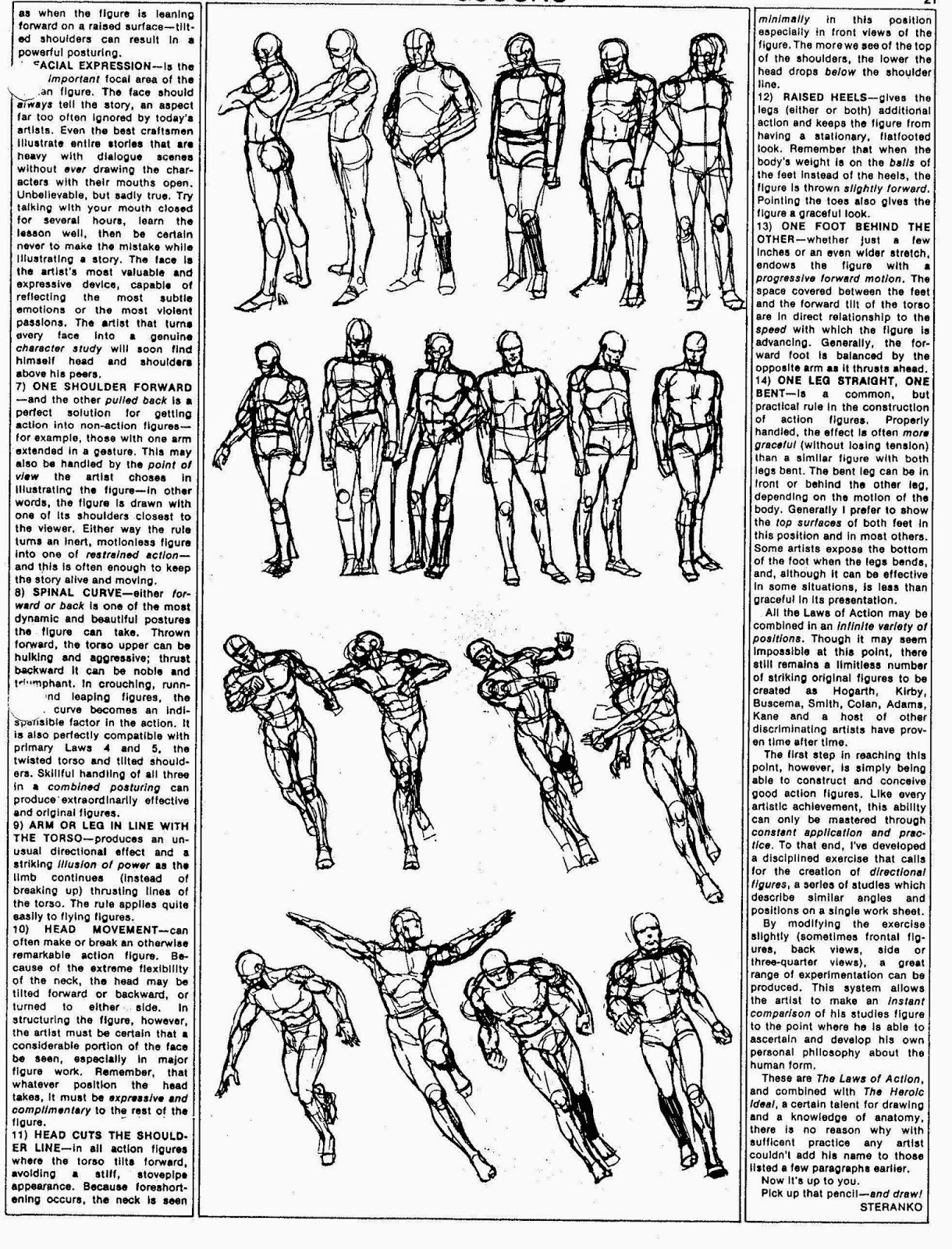
Later, in his self published magazine Media Scene, he wrote an article titled: The Laws of Action" in which he describes how an artist can bring energy, expression and grace to a figure. It is a manifesto that is useful for all figurative artists. Let me know what you think.


* All quotes above taken from "The Laws of Action " by Jim Steranko.


Wednesday, February 26, 2014

The Two Michelangelos: Postscript - Another Contarelli Chapel Commission


Caravaggio was contracted for two side paintings in the Contarelli chapel, those we have looked at in the last three posts. The project was finished and installed in 8 months. For the front wall of the chapel, the Flemish sculptor Jacob Cobaert was commissioned to complete a "St. Matthew and the Angel" which was rejected for unknown reasons a short while after being installed. The sculpture ended up in Santissima Trinita dei Pellegrini in Rome.


The church turned once again to Caravaggio, asking him to complete a painting for the space. Caravaggio produced this work:


The church rejected this painting as well and if we take a closer look it is easy to understand why. The angel is guiding St. Matthew's hand which, combined with the look on his face, makes him look rather like a simpleton. In addition, the position of the Saint's dirty left foot puts it precariously close to the  eucharist when it is raised during the liturgy. The painting eventually ended up in the Kaiser-Friedrich Museum  in Berlin and was destroyed by American bombing in World War II. 

Caravaggio, being the consummate professional that he was, painted a second version that remains in the chapel to this day:


For amazing hi-res images of the paintings in the Chapel visit: Contarelli Chapel hi-res pics.
And an interesting documentary on how they produced the above images: Caravaggio, creating three facsimiles.


Sunday, February 9, 2014

The Two Michelangelos Part 2


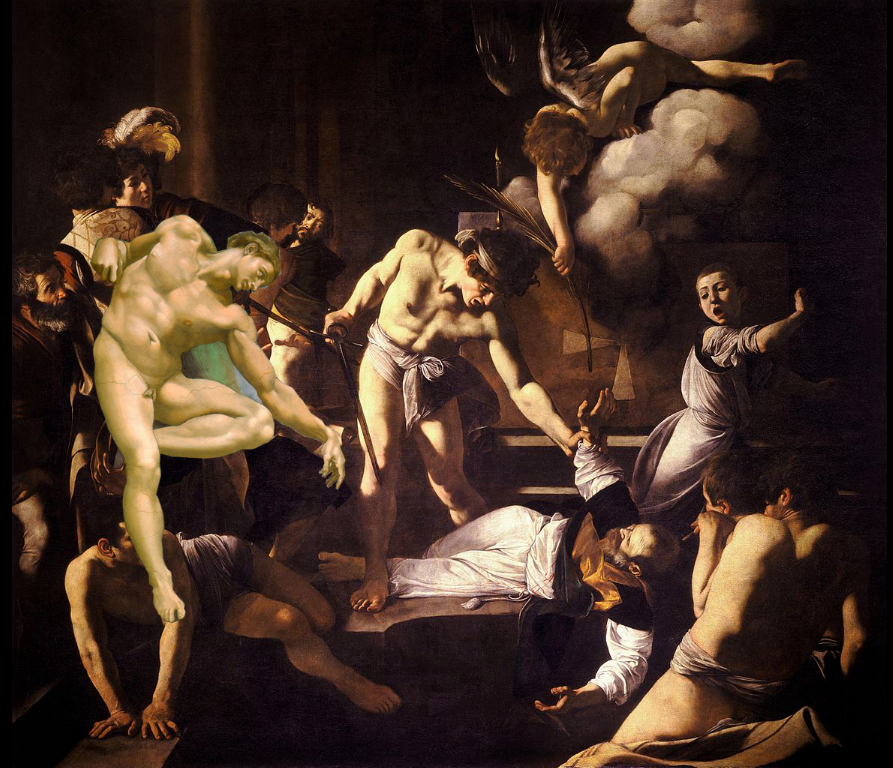
This is the "Martyrdom of St. Matthew" from the Contarelli Chapel in San Luigi Francesi in Rome.


Caravaggio's version of the martyrdom was inspired by the Golden Legend .  Matthew was murdered while celebrating mass in the Ethiopian city of Nadaber. He had refused to marry the King Hirtacua to Ephigenia, a consecrated virgin. Upset at this, the King sent an assassin to kill the saint.

The white vestments of Matthew set against the dark background bring our attention to the center of the painting, as the assassin stands over the saint, about to kill him. At left we see a group of young men (including Carvaggio's self portrait at the back)  dressed in contemporary 17th C clothing (as in the "Calling"). This group could be the faithful who, upon witnessing the murder, ran to light fire to the kings palace. On the right is the altar boy running away from the scene while just behind him is the altar. The bottom group is somewhat confusing as it seems the figures are distorted and/or limbless. Could this refer to the cripples that St. Matthew was known for healing? The strange space they are in may be a reference to the Pool of Bethedusa – a healing pool in Jerusalem mentioned in St. John’s Gospel. 

It is the grouping of St Matthew and the assassin that is most interesting. Once again Caravaggio references Michelangelo's Creation of Adam, using the body of Adam in the place of the assassin. Below I have photoshopped Adam next to the assassin to demonstrate the similarity:


This assassin is Adam up right, on his feet. Adam who has become sinner and been exiled from Paradise. The assassin/Adam grabs the hand of Matthew, trying to block contact with the palm of martyrdom being offered to him by the angel above. Adam here is an image of arrogance in contrast to the redemptive power offered to Matthew. It is sin that prevents us from receiving the grace of God. In this grouping Caravaggio represents the complex rapport between human and divine.

With  "The Calling of St. Matthew", the hand of Adam became the hand of Christ that calls Matthew. In "The Martyrdom", the body of Adam just created becomes the arrogant body of the assassin of St. Matthew. The angel above Matthew is one of the angles from the flight of the angels within God the Divine Creator.

In the next post we will see how Caravaggio continues to reference the Sistine Chapel in his painting of  "Supper at Emmaus"