Friday, October 30, 2015

Off the Coast Podcast - A Conversation with Antonio Macedo


Having spent some time in Portugal has allowed me to make friends with a number of artists living and working there. One of these, the painter Antonio Macedo, invited me into his studio recently where we talked about his experience as an artist. Working professionally for 40 years, the conversation will be of interest to young artists just starting out as Antonio shares his ideas of what painting should be.


Antonio's website: http://antoniomacedo.pt/en/ 
Antonio is also active on Facebook: https://www.facebook.com/antonio.macedo.54?fref=ts
Music for the podcast is by Kid Cholera courtesy of Opsound.org

Tuesday, August 4, 2015

Apothesis of the Renaissance


Also known as the "Glorification of the Renaissance". Completed by the Hungarian painter Mihaly Munkacsy in 1888, this ceiling painting from the Kunsthistoriches Museum in Vienna is a  representation of the atelier of the Renaissance Masters. In the bottom left we see Raphael and Leonardo conversing with Veronese working on a large canvas just behind them. In the centre is Titian instructing a young student working from the model. Just below and to the right is Michelangelo with hammer,  leaning on a balustrade.  In the loggia above is in Pope Julius II whose papacy was marked by ambitious building projects and patronage for the arts. The goddess could be Ozwiena, the Slavic goddess of Fame and Glory or the Allegory of Peace and Prosperity.
Just above the reclining female is the self-portrait of Munkacsy, considered one of the most important painters of 19th century Hungary.

Sunday, July 5, 2015

Portrait Painting in Firenze 2015

I have just completed the my 2015 edition of portrait painting. This year we had 14 students and eight models.


Students worked from a combination of life and photographs to incorporate the best of both in one painting. Essentially students used the photo for the drawing stage and the model to check colours and values. The goal was to make an interesting painting and so students worked within a traditional system used by master artists. A variety of examples of systems were explained and shared and students choose one they liked.


As part of the instruction I painted a demo from life explaining my process along the way:


Block-in with umber after 30 minutes

Completed painting 8 hours


Thursday, October 23, 2014

Artistic Anatomy - Odd Nerdrum


Odd Nerdrum is  one of the most interesting and important artists alive today. Nerdrum's pictures reflect the spiritual malaise which overwhelms post-modern man. His paintings are timeless, yet radically traditional.
The figures of Nerdrum's (seemingly) post-apocolyptic landscapes reflect a clear belief in the manipulation of anatomy to express a mood or an idea. The master himself talks about this:
"The highest level you could think about is when you make a picture where you can't say when it was made. You have to make small heads, big hands, long stomachs, so the whole figure is moving upwards". (https://www.youtube.com/watch?v=oUrP2cvtFJ4#t=21m34s)

"Two Green Feathers" 

"The Singers"

In other of Nerdrum's paintings he distorts the figures in a less graceful way.

"Woman Kills Injured Man"

Man Bitten by a Snake 

Nerdrum works exclusively from life, with multiple sittings from multiple models. He selects those features he needs, distorting and interpreting to create the characters that populate his landscapes.
As an example of this, in my time studying with Nerdrum, I was asked to pose for one of the figures in a painting, that of an old wizard. The model for the wizard was a well-built older gentleman with a healthy head of hair while the figure in the painting was bald. My head came in handy as I was the only bald student around.


This quote from the website sine qua non sums up Nerdrum's work beautifully:

"In Nerdrum's work the body and its natural functions - erections, defecation, even aging- are used to jolt us out of our tidy complacency. His blighted landscapes also do much to increase the overall disquiet. 
But at the core, the essence, Nerdrum's paintings violate with one final traumatic twinge: that of almost unbearable beauty"

For more pictures of unbearable beauty: http://www.nerdrummuseum.com/Paintings.php


Sunday, October 5, 2014

Dimension Bomb


Koji Morimoto is one of Japan's premiere anime artist/directors but his work is not well known outside of his homeland. I was never a huge manga or anime fan but I happened to see a show of drawings and paintings from various anime projects while I was in Madrid a couple of years ago. It lead me to look into Morimoto's work. 

If you have 20 minutes you will be transported to another world. Morimoto's film is wonderful.


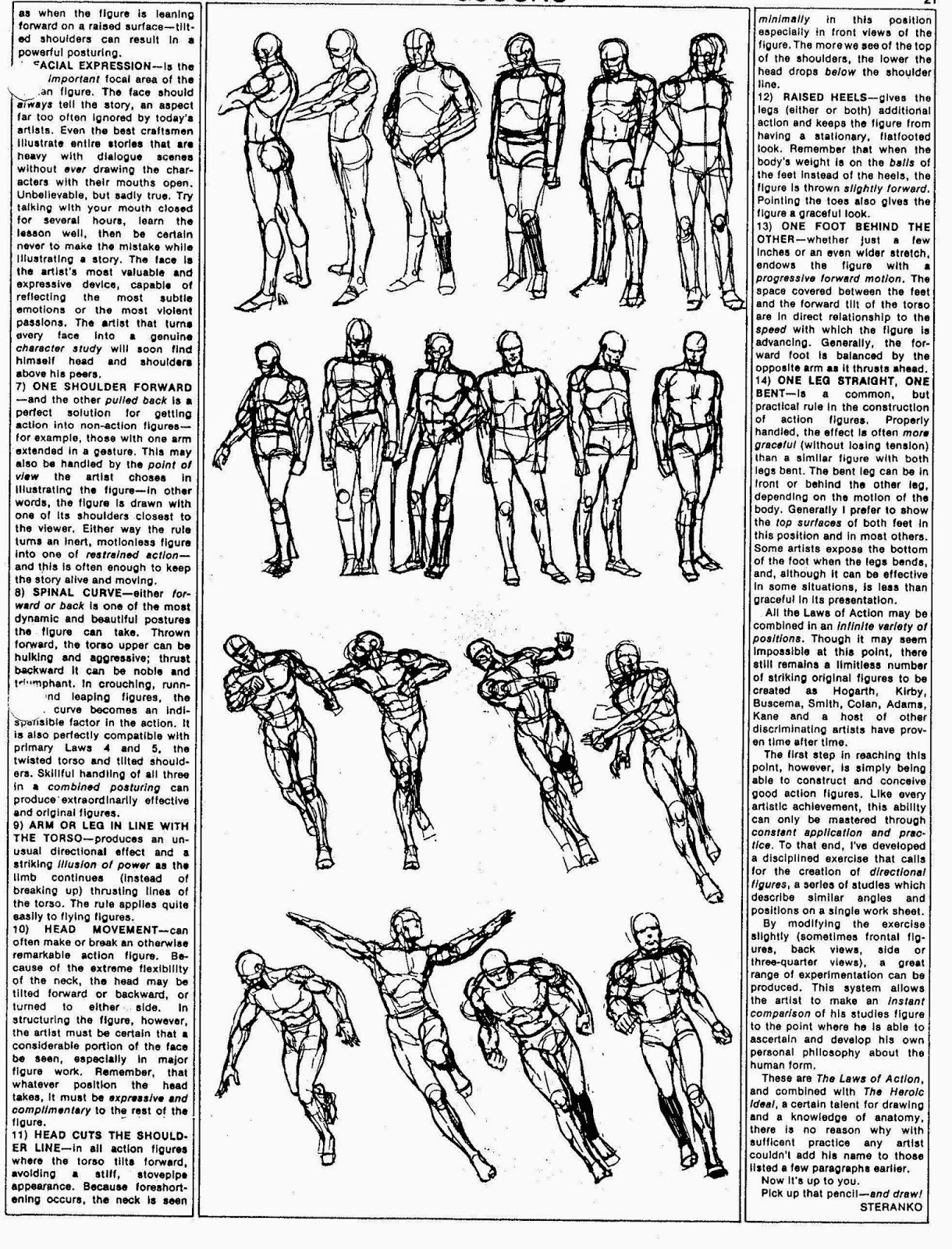
Artistic Anatomy - Kirby, Steranko and the Laws of Action

What is "artistic anatomy"? It is the deliberate distortion of anatomy in order to make an artistic statement which may (or may not) support a philosophical idea. Artistic anatomy is the "...practical application of learned anatomy for heightened dramatic effect and maximum visual impact. Just as the most elegant words have no effectiveness unless they are used properly in a sentence, anatomical expertise without intelligent and judicious application will fail to communicate even the finest draughtsman's attention."* In today's academies, students are taught fidelity to nature and accuracy of seeing which makes for excellent work which however can sometimes be a little sterile. Interpretation and distortion for the sake of expression is often overlooked when drawing and painting figures.

For much of the 20th century, particularly in the dark days of the 60's and 70's, comic books were where much of the figurative tradition lived. Comic books are a great way to start of a series of posts on artistic anatomy considering that the simplification and distortion of anatomy is key to the art form.

The greatest comic artist of all time,  Jack Kirby, is a example of an artist using artistic anatomy,


Kirby's early work showed a mastery of anatomy but by the end of his career he had developed a short hand for anatomy that was distinctly his. Squiggly lines and sharp, straight lines interplay across the surface of his figures lending a sense of action and urgency to them.  This is the essence of artistic anatomy in the comic medium - "the amplification of anatomy to the point of impossibility and beyond."*


Also typical of  Kirby are the oversized hands, bodies at 8 heads or more tall and exaggerated musculature.  A hallmark of figures in heroic art:

Michelangelo

Pontormo

El Greco

Jim Steranko was a young graphic designer who had a short but fantastic run on a series of Marvel Comics in the 1960's. He took Kirby's language and made it his own:


Later, in his self published magazine Media Scene, he wrote an article titled: The Laws of Action" in which he describes how an artist can bring energy, expression and grace to a figure. It is a manifesto that is useful for all figurative artists. Let me know what you think.


* All quotes above taken from "The Laws of Action " by Jim Steranko.


Saturday, September 20, 2014

A Glimpse of Divine Perfection

"The love of human beauty was the first step towards the love of God's own splendour" - St. Augustine
"A beautiful human body is thus a glimpse of divine perfection" - Dr. John Spike


In my on-going attempt to improve my artistic anatomy I thought I would share some of the recent sketches in my sketchbook. The sources come form a variety of places - wherever I see a beautifully designed body. Fine art, comics and illustration, drawing manuals as well as photographs. I am trying to absorb the mechanics of the body, to memorize the forms and understand how various artists distort the figure for a particular effect.


In an upcoming post I will discuss artistic anatomy and show examples from the range of art history.