Thursday, June 24, 2010

Beauty Part 1


The great artists of the past were aware that human life was full of chaos and suffering, but they had a remedy for this and the name of that remedy was Beauty. - Roger Scruton
http://www.youtube.com/watch?v=65YpzZrwKI

Sunday, June 20, 2010

Building a Mural - Part 1

The last couple of entries have been about drawing figures without a model and then putting those figures into a convincing space. I would like to share know how an artist (me) uses that knowledge to develop a picture from idea to concept sketch and on to finished painting.

Last year I was commissioned by a community in Calgary to paint a mural on the theme of world peace. My idea was to place the traditional figure of Peace - a winged woman with a palm branch- into a modern setting. Here are the steps I went through to get an approved sketch.

The first step is to just draw small quick sketches. Things start off slow but soon the pencil flows a little easier.


From the initial sketches I picked a couple and developed them into a slightly more finished sketch.


The client liked the idea of the peace figure coming down to meet the people. I developed the composition and added a range of ethnicities:


This is the final step in the development of the image. In the next entry I will show how I moved from this sketch to final colour study and readiness to paint.

Wednesday, June 2, 2010

Figures in Space 2

After one has spent a considerable amount of time practicing drawing the figure without a model (the old saying goes we all have 10 000 bad drawings in us which we have to get out), the next step is to place those figures in a convincing space.
The following images are taken from Andrew Loomis' book "Figure Drawing For All It's Worth" (http://fineart.sk/index.php?cat=1or www.alexhays.com/loomis/). They are an excellent demonstration on how to put the figure into a drawn perspective space.


Leonardo da Vinci using one point perspective:


Examples of other artists placing figures in perspective:

Andrea Del Sarto


Alma-Tadema


Gerome


Byrne


Gurney


Repin

Wednesday, May 5, 2010

Figures in Space (Drawing from Me Head part 2)

Figurative artists, in order to be successful, must learn two basic skills. The first, taught by a number of academies all over the world, is visual training. Learning to draw is first and foremost learning how to see. In order to master this skill one must spend countless hours copying drawings by old masters and drawing the figure from life all under the critical eye of a qualified instructor. The second skill is the constructive approach to drawing. Here the student learns the basic forms and anatomy of the human figure with the aim to draw the figure from imagination. Below are some hints, leads and images to get you started mastering this skill.

Instructors
Far and away the best instructor in the field of constructive figure drawing is Glenn Vilppu. Check out his website for copies of his wonderful videos: www.vilppustore.com. If you can, buy them all.
This web address contains a number of online articles by him: www.awn.com/category/columns/vilppu

Comic book artist David Finch recently released an excellent drawing dvd:
www.thegnomonworkshop.com/news/2010/02/new-dynamic-figure-drawing-series-with-david-finch

Websites
www.posemaniacs.com/blog/pose
http://figure-drawings.blogspot.com
www.alienthink.com

Books available on the web:
Andrew Loomis was an illustrator and suberb draughtsman in the golden age of illustration. He wrote several books on drawing which are very helpful, particularly "Figure Drawing for All it’s Worth" and "Drawing the Head and Hands".
They are available online here:
http://fineart.sk/index.php?cat=1
or here:
www.alexhays.com/loomis/

Other Books:
"How to Draw Comics the Marvel Way" by Stan Lee
"Drawing The Head And Figure" by Jack Hamm

The Process:
1. Beginning Form: Start by drawing this simple form of a sphere and cube covered by some material. Do not move forward until you become very good at drawing these.


2. Transitional Form and the Simple Mannequin: The beginning form acts as the rib cage and pelvis. Now add the columns of the legs and arms to make a simple mannequin.


John Buscema's mannequin:


Glen Vilppu:


One can also use a mannequin based upon the cube form:


3. Complex Mannequin: Now add simple anatomy. The shoulders and pectorals are grouped together. The external obliques, abs and underwear shape of the pelvis are the other forms.


In the image below notice simple proportions to help you with your mannequin:
Pit of neck to bottom of sternum equals sternum to tenth rib equals rib to pelvic points.


These are the basics, now you only need to draw, draw, draw.

UPDATE: The following images show how to combine superior knowledge of anatomy and the constructive method of drawing:

Alex Raymond:


Simone Bianchi:

Wednesday, April 28, 2010

A Tale of Two Churches


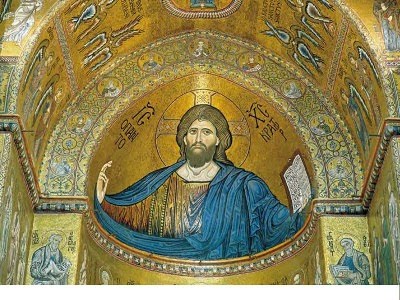
The Cathedral of Monreal and Saint Eldrado are two churches from the same era, on opposite ends of the Italian peninsula, that share much in common and have some important differences.
Monreal, Sicily is located 15 km outside of Palermo and it’s cathedral is one of the most beautiful Christian churches in existence. Commissioned by William II (1154-89), the Norman ruler of Sicily, in 1174 the church is 102m long, 40m wide, 35m high. Its simple exterior hides the rich interior, covered with golden Byzantine mosaics illustrating bible stories. Over 2000 kilos of pure gold were used as the ground for these mosaics. Over looking the entire interior is the beautiful image of Christ Pantocrator (above).


Saint Eldrado is located in the Susa valley, one hour outside of Torino, a part of the Novalesa Abbey. Built on the ruins of an older church, Saint Eldrado was begun in the early 11th century and frescoed at the end of the century. As such, it's frescoes bear a resemblance to the images in Monreale, most notable the image of Christ Pantocrator(above). The fresco cycles themselves, which illustrate scenes from the lives of Saint Eldrado and Saint Nicola, are in beautiful condition. The Normans too, used this church, most likely before they sent out to cross the Appenines, as the abbey lies at the mouth of the passage. It is a tiny church no more than 4 meters wide by 20 long and continues to be used by the monks to this day.


Sunday, April 11, 2010

Thanks to Annigoni


I have four paintings in an upcoming show, Annigoni's Legacy, at the Villa Bardini in Florence in May. The occasion is the centenary of the birth of the painter Pietro Annigoni.

Annigoni kept alive the classic tradition in the dark days of 20th century painting. The painter I studied with, Micheal John Angel, studied with Annigoni in the 1960's.


Below is Annigoni's Manifesto of “Modern Painters of Reality”:

(Pittori moderni della realtà) Milan, Italy, November 1947

We, “The Modern Painters of Reality” are gathered in a brotherly group to show our works to the public.

The favor and understanding with which the public has accompanied and supported our efforts over the last few years, our certainty to be in the right and that the others are wrong, have convinced us of the advisability and necessity of this exhibition.

We stand united with our strength, our faith, our ideals and our absolute mutual esteem. As opposed to the Ecole de Paris, born in France, but representative of a universal tendency of decadence, our art born in Italy represents an event of hope and salvation for art and this exhibition is meant to be a first effective contribution to the fight that is about to blaze.

We are neither interested nor moved by the so-called “abstract” or “pure” painting, procreated by a decaying society, which is empty of any human contents and has retreated into itself, in the vain hope of finding a substance in itself.

We disavow all contemporary painting from post-impressionism till today, regarding it as the expression of an age of false progress and a reflection of the dangerous threat that looms over mankind. On the contrary we reaffirm those spiritual and moral values without which painting would become the most fruitless exercise.

We want painting to be moral in its most intimate essence, in its style itself, a painting that in one of the dimmest moments of human history should be filled with the same faith in man and his destiny, that had made the greatness of art in times past.

We recreate the art of illusion of reality, the eternal and primeval seed of figurative arts.

We do not lend ourselves to any comeback, we simply keep on with our mission of true painting, which is the image of a universal feeling, which we want to be understood by many, not just by few “sophisticated ones”.

Long before gathering, each one of us had deeply felt the need to research in nature the leading thread that would allow us to find our true nature in the labyrinth of schools that have multiplied over the last half a century.

Each one of us has spontaneously addressed himself to reality, the first and eternal source of painting, confident to find his own expression in it.

In the face of a new academism or conventionalism, made up of the remnants of cubist formulas and of a standardised impressionistic sensuality, we have exhibited a way of painting that, mindless of fashions or aesthetic theories, is striving to express our feelings through the language that each one of us, according to one’s temperament, has found by looking directly at reality.

Sunday, November 16, 2008

The Ecstasy of Truth


The German filmmaker Werner Herzog, in recent interview, talked about the role of factual reality in filmmaking. He had this to say about the liberties he takes with facts in some of his documentaries:

"If we are paying attention about facts, we end up as accountants. If you find out that yes, here or there, a fact has been modified or been imagined, it will be a triumph of accountants to tell me so. But we are into illumination for the sake of a deeper truth, for an ecstasy of truth, for something we can experience once in a while in great literature and great cinema."

This statement applies equally to art. A still life is not simply an even rendering of a group of objects any more than a shopping list is a piece of literature. Take for example the difference between these two "realist" paintings:


The top still life by Stephen Gjertson is an impressive piece, definitely what we would call realist art. There is no denying the artist's ability to reproduce what he sees onto a flat surface. Everything is clearly represented and experienced to the same degree, which, quite frankly, is a little boring and not representative of we we experience the world around us. In the long run this painting leaves me a little cold.
The second painting by David Leffel is a much more powerful work. It is accurate and abstract at the same time. There are artistic decisions which have been made. He has modified and interpreted reality into a work of art that speaks about how we see and experience reality. This is a painting to be dreamed into and lived with.

We painters need to find our special way to an ecstasy of truth.