Sunday, February 9, 2014

The Two Michelangelos Part 2


This is the "Martyrdom of St. Matthew" from the Contarelli Chapel in San Luigi Francesi in Rome.


Caravaggio's version of the martyrdom was inspired by the Golden Legend .  Matthew was murdered while celebrating mass in the Ethiopian city of Nadaber. He had refused to marry the King Hirtacua to Ephigenia, a consecrated virgin. Upset at this, the King sent an assassin to kill the saint.

The white vestments of Matthew set against the dark background bring our attention to the center of the painting, as the assassin stands over the saint, about to kill him. At left we see a group of young men (including Carvaggio's self portrait at the back)  dressed in contemporary 17th C clothing (as in the "Calling"). This group could be the faithful who, upon witnessing the murder, ran to light fire to the kings palace. On the right is the altar boy running away from the scene while just behind him is the altar. The bottom group is somewhat confusing as it seems the figures are distorted and/or limbless. Could this refer to the cripples that St. Matthew was known for healing? The strange space they are in may be a reference to the Pool of Bethedusa – a healing pool in Jerusalem mentioned in St. John’s Gospel. 

It is the grouping of St Matthew and the assassin that is most interesting. Once again Caravaggio references Michelangelo's Creation of Adam, using the body of Adam in the place of the assassin. Below I have photoshopped Adam next to the assassin to demonstrate the similarity:
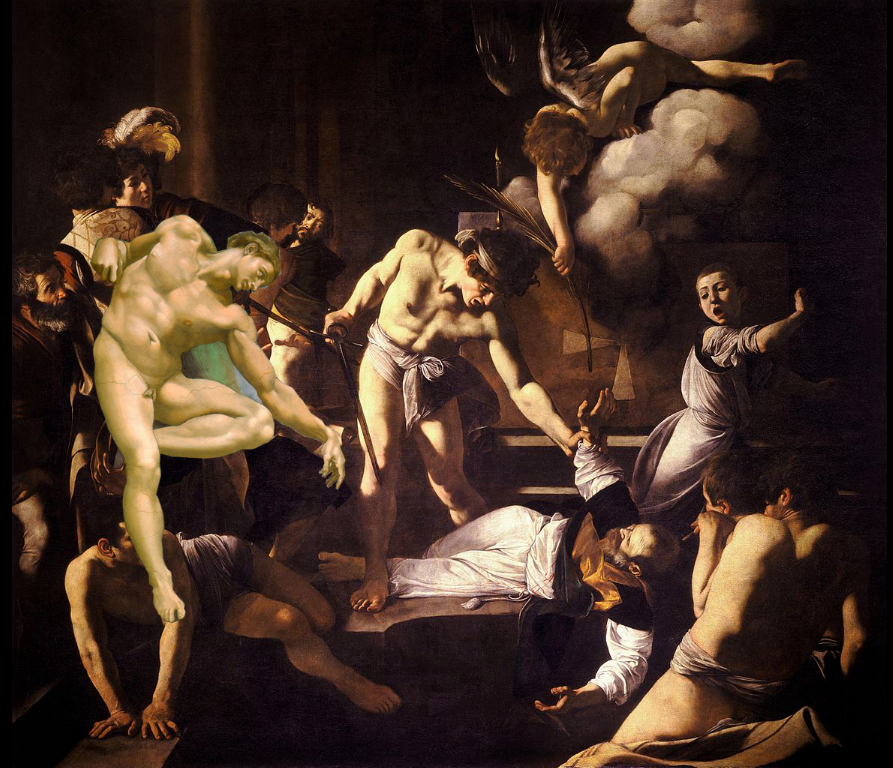

This assassin is Adam up right, on his feet. Adam who has become sinner and been exiled from Paradise. The assassin/Adam grabs the hand of Matthew, trying to block contact with the palm of martyrdom being offered to him by the angel above. Adam here is an image of arrogance in contrast to the redemptive power offered to Matthew. It is sin that prevents us from receiving the grace of God. In this grouping Caravaggio represents the complex rapport between human and divine.

With  "The Calling of St. Matthew", the hand of Adam became the hand of Christ that calls Matthew. In "The Martyrdom", the body of Adam just created becomes the arrogant body of the assassin of St. Matthew. The angel above Matthew is one of the angles from the flight of the angels within God the Divine Creator.

In the next post we will see how Caravaggio continues to reference the Sistine Chapel in his painting of  "Supper at Emmaus"

Wednesday, February 5, 2014

The Two Michelangelos Part 1


Michelangelo Buonarotti and Michelangelo Merisi da Caravaggio that is.

Caravaggio, like any master, understood art history and was able to play with the language of art to make complex theological statements. A continual source for him was Michelangelo and we find Caravaggio quoting the great master in many of his paintings.

In the Contarelli Chapel (1599 - 1600) in San Luigi Francesi in Rome, Caravaggio was granted his first major commission. On his death in 1585 the French cardinal, Matthieu Cointerel (Contarelli in Italian) had left a large sum of money and instructions for a chapel to be dedicated to his patron saint, St. Matthew. Caravaggio completed the commissions on canvas, something unheard of for large murals at that time which were usually executed in fresco. Three large painting were finished in 8 months.

In the first painting, "The Calling Of St Matthew", we see Christ calling Matthew, aka Levi, as described in Matthew 9.9: "And as Jesus passed forth from thence, he saw a man, named Matthew sitting at the receipt of custom: and he saith unto him, follow me. And he arose, and followed him."


Caravaggio gives Christ the hand of Adam from the Sistine Chapel's "Creation of Man", signalling the similarity between God and man and the human nature of Christ: Christ is the new Adam. Notice also how Peter, the first pope, echoes the gesture, describing how the Church continues the work of Christ.


Matthew and his colleagues are dressed in clothing contemporary to Caravaggio, from the early 17th C, while Christ and Peter are dressed in what would be early 1st C wear. This emphasizes that Christ's call is eternal, for all people of all ages.

Caravaggio was the perfect counter-reformation painter. A complicated individual but entirely professional and profound in his work. In the next post we will look at the complex and interesting theology presented by Caravaggio in a second painting in the chapel, "The Martyrdom of St. Matthew".

Monday, January 6, 2014

Blood Pudding

While in high school in the 80's, my friends and I used to make Super 8 movies to keep ourselves busy outside of school. They were actually the brainchild of my best pal Paul, who had aspirations of being the next George Lucas. In the 90's Paul went on to a make some fine features but earlier, circa 1992, he had come across some black and white 8 mm film and had an idea for short he wanted me to star in.  I was, at the time, in my "artist" phase, sporting long hair and a beard, apparently the perfect look for the homeless lad whom this movie is about. So, using all our old high school pals and locations we had easy access to, we shot this little film over a couple weekends. Paul entered it in the 1st Annual Calgary Independent Film Festival and we got a nice review on the CBC, something about the film being 'a profound statement on modern life'. I won the best actor award.

Ladies and Gents, Blood Pudding.


Monday, December 16, 2013

Lords in Sydney

The Art Gallery of New South Wales in Sydney has a fabulous collection of 19th Century art, among them a number of Leightons.

Winding the skein

The paintings filled the space, displayed like a 19th century salon. Photos turned out blurry so I shot some video: 


The website of the AGNSW has excellent pics of the collection, many hi-res. Worth taking a look:

Wedded

Friday, December 13, 2013

"My Story" by Annigoni ( or how I found Annigoni Down Under)


"It is a story filled with beauty, happiness and tears, which every man and woman will be moved to read."


While in Australia I had a couple of run-ins with Pietro Annigoni. Annigoni, for those who do not know, was the Italian oil and fresco painter who became famous after painting Queen Elizabeth II's portrait in 1956. John Angel, my maestro in Florence was a student of Annigoni's, so Annigoni is sort of my artistic grandfather.
While browsing the stacks at an used book store in Sydney I came across this:


It just seemed kind of random, this faded print in the cheap wood frame among  three floors of novels, bios, text books and art books. I had never seen an Annigoni print outside of Italy. I wondered who put it up. It seemed to have been there a while.

Earlier in the month, during the final days of my Tasmanian workshop, one of my models had purchased an old suitcase at the local market in Launceston. Inside were an number of magazines and among them I noticed this image:

`
Inside was a centerfold of the portrait of Princess Margaret:


What I had overlooked however, was the story that went with the image. Titled "My Story", Annigoni tells his life story. Here are the pages for you to read:


Unfortunately I have not yet found the next issue so we can not finish reading his story. Instead I leave you with this old clip on Annigoni and the  portrait of Princess Margaret.


Monday, November 25, 2013

Demo Down Under

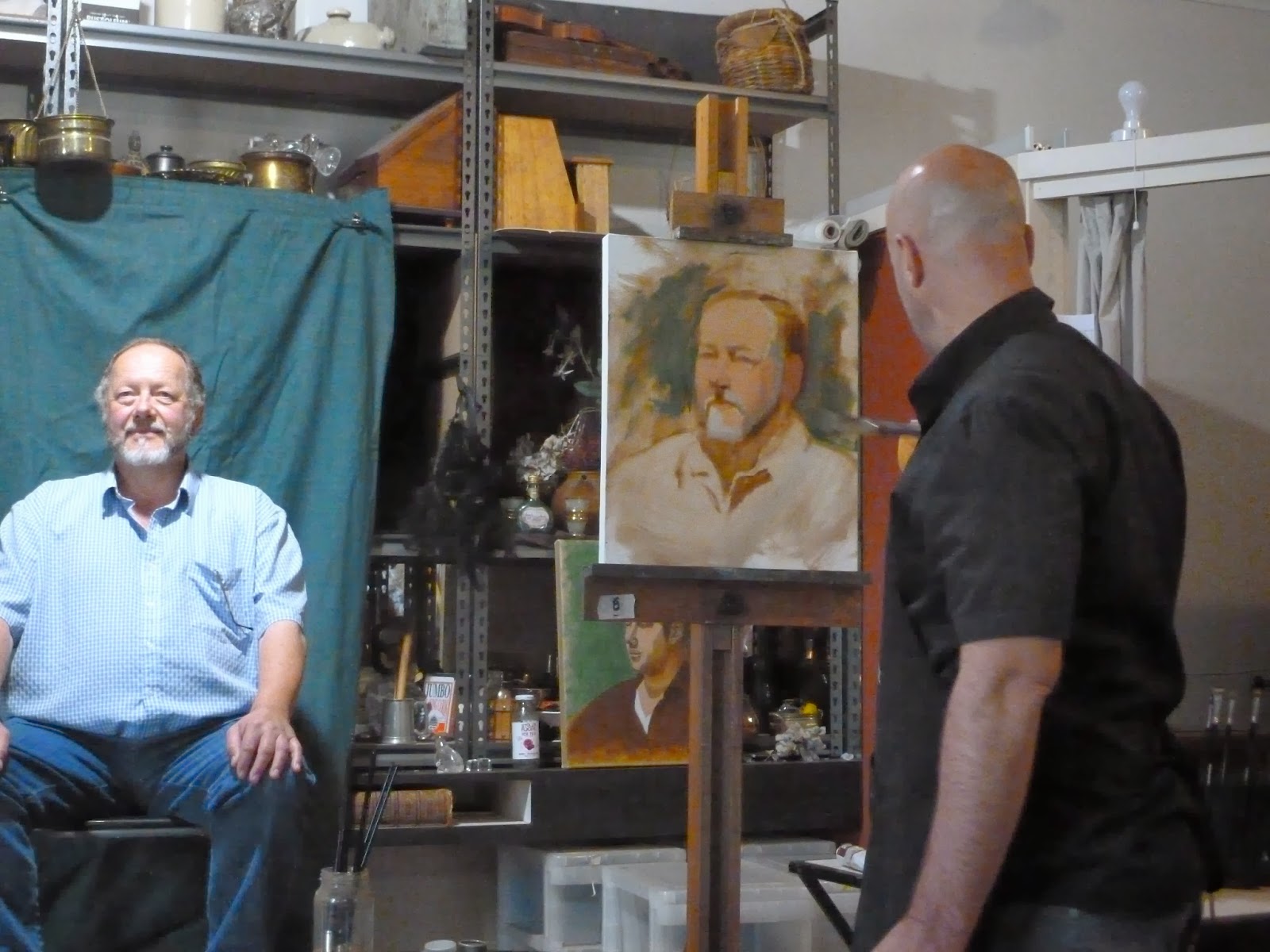
This past Saturday afternoon I did an alla-prima portrait demo at Leoni Duff Studios in downtown Launceston. For students in my workshop and the  public, the idea was to show the steps in the completion of a portrait collapsed into a couple of hours. Leoni's husband Alan was kind enough to offer his handsome face for me to paint.


The following progress shots were taken at various points over 2.5 hours:

Setting proportions


Wash drawing


Beginning colour lay-in

Setting background colour

Modelling planes


Adding smaller forms

Fixing shapes


Completed portrait - 
One can always use just one more sitting


Above pics by Lynne Davies, Darren Day and Joanne Mitchelson - Thanks!


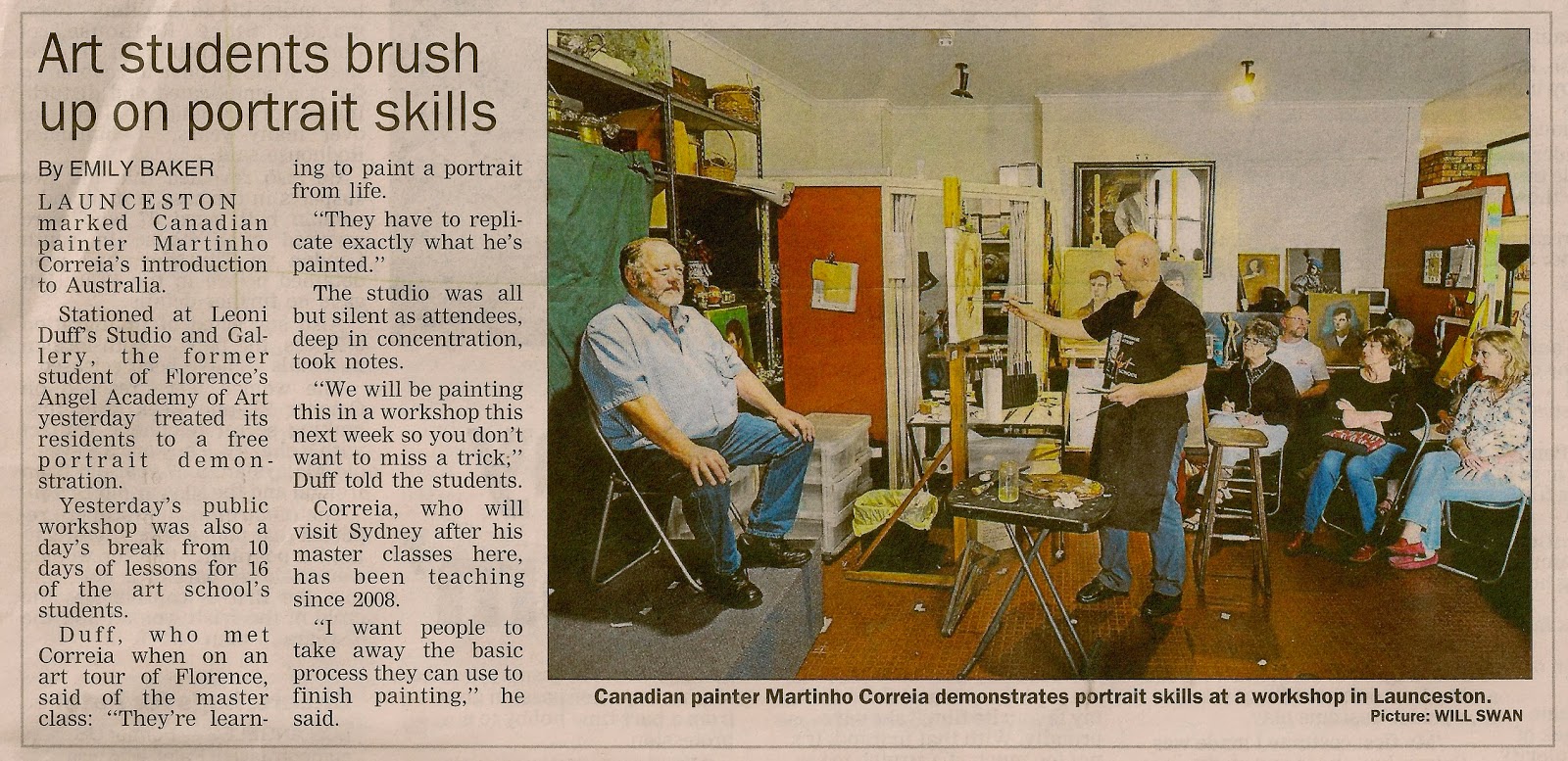
Some press coverage from the Launceston Examiner, Nov. 24 2013.